Then these mixtures become your own and you will have knowledge of how best to orchestrate them on your design.
Watercolor education, processes and step by step lessons, for Brigham Young University-Idaho Students, Educators and Groups or Individuals furthering their skills. Gallery site for posting my watercolor work. Web site SallyCannonEllis.com
Friday, December 9, 2011
Mixing Purples, Oranges and Greens from primary hues.
Then these mixtures become your own and you will have knowledge of how best to orchestrate them on your design.
Wednesday, November 30, 2011
Composition Devices and Resource Reconstruction
Compositional Devices
Ways in which artist can organize the elements and principles of design are called a composition device.
Like Music and Writing, Compositions fall into categories:
The Definition of a cat·e·go·ry/ˈkatəˌgôrē
| NOUN: |
|
Music categories : Classical, Western,Modern, Rock, Gospel and Ballads
Writing Categories: Fiction, Biographies, Romance, Narrative, Memoir, Poetry, Short Story, Speeches.
Monday, November 28, 2011
Salt Lake City Temple. Temple Square Salt Lake City Uath
This is the Salt Lake City Temple at Christmas time. The Salt Lake Temple is in, of course in Salt Lake City, Utah, United States of America. My Great Grand Parents helped build this temple, it took forty years. The Temple is a sacred house of the Lord Jesus Christ.
The photo was taken by my husband Dr. Jay T Ellis "HTC, Droid Incredible" Cell Phone.
Thursday, November 17, 2011
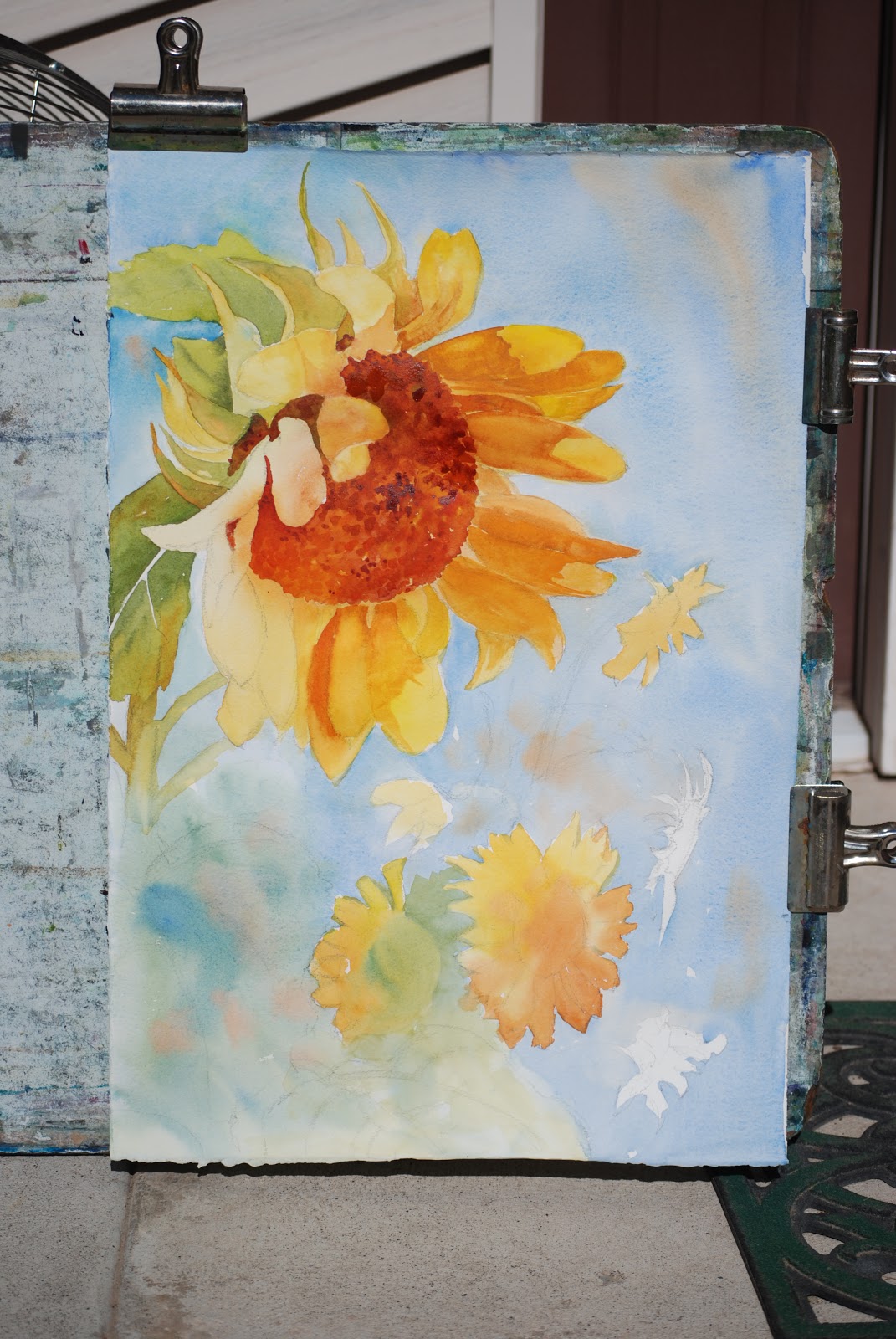
Wet in wet and direct painting method. Sunflower resource
Wet in wet process. The large sunflower was left white by painting water around the flower then adding pigment into a wet in wet method.
Great first wet in wet wash with excellent water proportion and pigment porportions.
Note the granulation of the wash as a result of enough water and the use of gravity by placing the piece on a slanted incline of about 20%.
Wednesday, November 16, 2011
Glazing: Using layering of transparent pigments. Trumpet flora.
Resource in color
Gray scale
<<<<<<<<<<<<<<<<<<<<<<
The shapes of values. Here are five flat values from the above gray scale.
Sketching your values in flat patterns help you see the interest of your shapes. Note the long gray line created by the shape 1/3 from the left side of the painting.
Now is this interesting or boring? This strong line cuts the painting, dividing the piece into a left and right side making it into two paintings.
To correct this add a gray shape into the light gray shape on the flower this will tie it together
and add a light shape without losing the form behind the gray line.
Step one always start with the lightest color.
Step two orange.
This one is a transparent mix of Aureolin and Quinacridone Rose
Step three add red. This red is Quinacridone Rose
Step four add a cool. This is Cobalt Blue or Ultramarine Blue.
This blue is very granulating I would say its Ultramarine Blue.
Which one would be the best to use? Depends on how dark the darks are in your resource.
Ultramarine Blue has a lower value straight from the tube then Cobalt Blue.
Finished piece is coming.
Step one always start with the lightest color.
Step two orange.
This one is a transparent mix of Aureolin and Quinacridone Rose
Step three add red. This red is Quinacridone Rose
Step four add a cool. This is Cobalt Blue or Ultramarine Blue.
This blue is very granulating I would say its Ultramarine Blue.
Which one would be the best to use? Depends on how dark the darks are in your resource.
Ultramarine Blue has a lower value straight from the tube then Cobalt Blue.
Finished piece is coming.
Wet in Wet washes. Warm North Grand Teton piece.
Resource is a photo I took at sun down. Value study placed in photo shop, then to gray scale
This is the back of the paper. Water was added to the back with a 11/2" sky flow flat brush.
Color was mixed first on my palette, being sure to mix enough color to do the entire first wash.
Water was added to the front of the paper painting water around the whites.
Note the heavy bead of pigment and water collecting at the top of each dry left white area.
Also I used the color mixtures in Zalton Szablo'a Color by Color to make part of the color selection for this piece. The color was perfect for a warm sundown.
Colors used: Cobalt Violet for its granulation and Manganese Blue for the same reason. Aureolin was also used for the warm yellow and Quinacridone Burnt Orange.
Also my cell phone.
My daughter called at the beginning of the wash to let me know the grades of her children.
My Grand Children. The phone was set on speaker phone and we carried on a great conversation and completed the first wash.
I don't always advice this; however I always take my children phone calls.
Here the bead has been taken out with a dry round brush.
The painting is still very wet. The slop of the mountain has been added using Ultra Marine Blue.
Adding middle to foreground trees. Pigment is heavy with less water. The painting is still very wet. Note how the trees spread easily.
More trees, varing value and hue.
Here I show my board and the paper being held down with clips.
As the paper stretches (and it will) I pull the paper tighter and re-clip.
I choose not to stretch the paper for wet in wet painting. Simply because I can not put water on the back of the paper to add extra moisture .
Note the form of the rocks starting to emerge.
Also the shape in the large white area is starting to draw my attention.
In the next washes I add more shapes in the whites to diminish this shape.
As one of my great students would say "Its lonely".
Close up of the resource.
Here I have drawn in the shapes with a pencil and measured out the masses of the form.
In the painting, the Tetons have been moved up, the trees varied and overlapping shapes have been added to the foreground.
Here the white trunks of the tree have been added by using the bevel at the end of the brush. I almost always start at the bottom of the tree trunk and push up with the handle of the brush. If it makes a dark line its still to wet. It it creates a white line it is still damp and pliable.
If nothing happens the painting has become to dry.
Magic of watercolor isn't called so for no reason.
Timing is wonderful, everyone will learn it in one form or another.
Its like telling some one what salty taste like.
Experience is essential in everything we do.
Be it good or bad. Just grow with it happily.
Friendly harmonious shapes have been added in the back ground whites.
Remember the lonely shape.
Another Great Happy Day.
Wednesday, November 9, 2011
Wet in Wet washes, Taggart Lake Trees
Subscribe to:
Posts (Atom)